There’s a small moment every coffee lover knows: the first pour, the bloom rising with that warm, earthy aroma, the quiet two minutes before the first sip. That moment shouldn’t be a mystery, and it shouldn’t require a barista certification either.
This is your complete guide to how to brew specialty coffee at home — every method, every ratio, and every fix for when a cup doesn’t turn out quite right. Whether you’re reaching for a V60, a French press, or your everyday drip machine, the goal is the same: a clean, balanced cup that actually tastes like where it came from.
This guide is part of our Brewing Guides series, and it grows every time we publish a new method.
What You’ll Need Before You Start
Great coffee starts with a few simple tools:
- A scale with a timer, precision beats guesswork
- A good grinder that gives you a consistent, even grind
- A gooseneck kettle, ideally with a thermometer, for water temperature control
Don’t have this gear yet? Don’t worry! at the end of this guide, we’ll show you simple alternatives using a kitchen spoon and a few smart tricks.
The Golden Rule: Burr Grinder, Not Blade
If you only change one thing about how you brew, make it this.
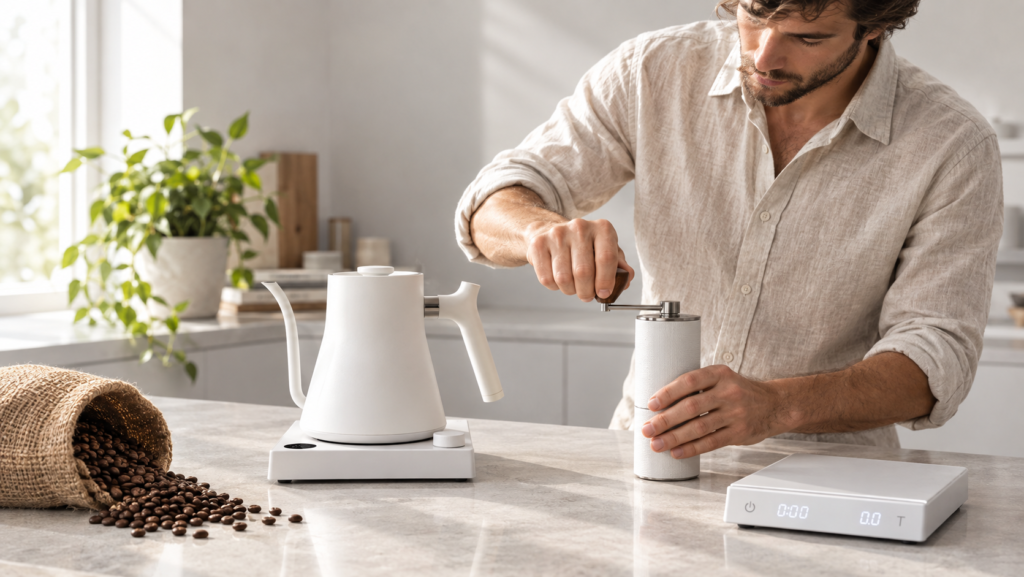
A blade grinder doesn’t actually grind your coffee, it smashes it. The spinning blade shatters the beans into wildly uneven pieces: some chunks stay large while others turn into fine coffee dust. When you brew that mix, the dust over-extracts almost instantly while the larger chunks barely extract at all. The result is a muddled, confused cup with a bitterness you can’t fix by adjusting anything else.
A burr grinder works differently. Two abrasive surfaces crush the beans to a uniform, controlled size — every particle extracts at the same rate, giving you a clean, balanced cup where you can actually taste the origin.
Do you want to found quality burr grinder options. Explore our hand grinders and brewing gear
This single upgrade changes more about your coffee than any other piece of equipment. A modest burr grinder will always outperform an expensive brewer paired with a blade grinder.
Table of Contents
Understanding Grind Size
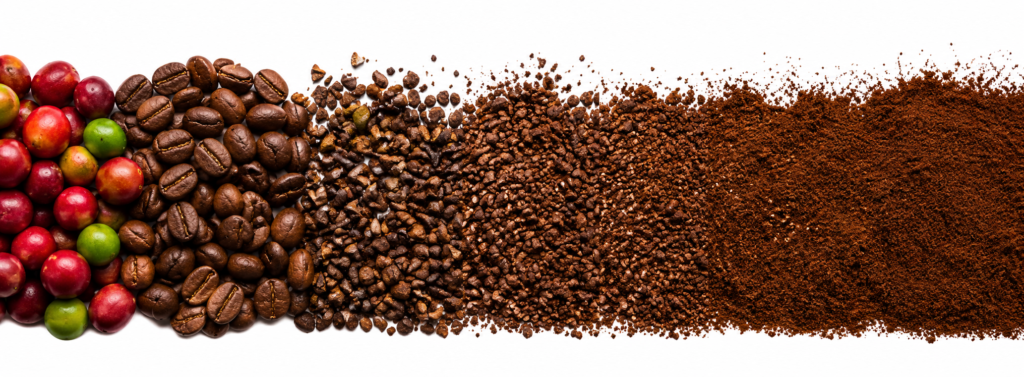
Grind size is one of the most overlooked variables in brewing — and one of the easiest to get wrong if you’ve never seen it compared to something familiar. Here’s a simple way to picture each one:
| Grind size | Looks/feels like… | Used for |
|---|---|---|
| Extra Coarse | Coarse sea salt rocks | Cold Brew |
| Coarse | Coarse sea salt / rough granulated sugar | French press |
| Medium-Coarse | Brown sugar / beach sand | Chemex |
| Medium | Table salt / fine sand | V60, Auto Drip |
| Medium-Fine | Fine table sugar | Aeropress |
| Fine | Fine table salt / cornmeal | Espresso, Moka pot |
Choose Your Method to Brew Specialty Coffee at Home
Every method brings out something different in the same beans. Here’s how to dial in each one.
Drip / Pour-Over Methods
Hario V60, Kalita Wave, Origami
| Grind | Ratio | Water Temp | Brew Time |
| Medium | 1:16 | 92–94°C | 3 – 3.5 min |
Dose: 15g coffee per cup (240ml) / 30g per two cups (480ml)
Chemex
| Grind | Ratio | Water Temp | Brew Time |
| Medium-Coarse | 1:16 | 94°C | 3.5 – 4 min |
Dose: 15g coffee per cup (240ml) / 30g per two cups (480ml)
Auto Drip / Coffeemaker
| Grind | Ratio | Water Temp | Brew Time |
| Medium | 1:16 | 92-94°C | 3 – 3.5 min |
Dose: 15g coffee per cup (240ml) / 30g per two cups (480ml)
Want to experiment with new ratios? Jump to Understanding Brewing Parameters below.
Immersion Methods
Aeropress
| Grind | Ratio | Water Temp | Brew Time |
| Medium-Fine | 1:16 | 92°C | 3 min |
Dose: 14g coffee per brew (224ml)
French Press
| Grind | Ratio | Water Temp | Brew Time |
| Coarse | 1:15 | 94°C | 4 min |
Dose: 16g coffee per cup (240ml) / 32g per two cups (480ml)
Cold Brew
| Grind | Ratio | Water Temp | Brew Time |
| Medium-Coarse | 1:10 | Room temp | 16 – 22 hours |
Dose: 15g coffee per cup (240ml) / 30g per two cups (480ml) Tip: use calcium-free water (bottled works well) for the cleanest cold brew results.
Want to experiment with new ratios? Jump to Understanding Brewing Parameters below.
Espresso
Espresso
| Grind | Ratio | Water Temp | Brew Time |
| Fine | 1:2 | 94°C | 27 – 28 sec |
Dose: 18g coffee per shot (36ml of water)
Want to experiment with new ratios? Jump to Understanding Brewing Parameters below.
Understanding Your Brewing Parameters
Behind every great cup are just two numbers worth understanding: ratio and temperature. Once you get these, you can adjust any recipe to match your taste, no guesswork required.
What Is Brewing Ratio?
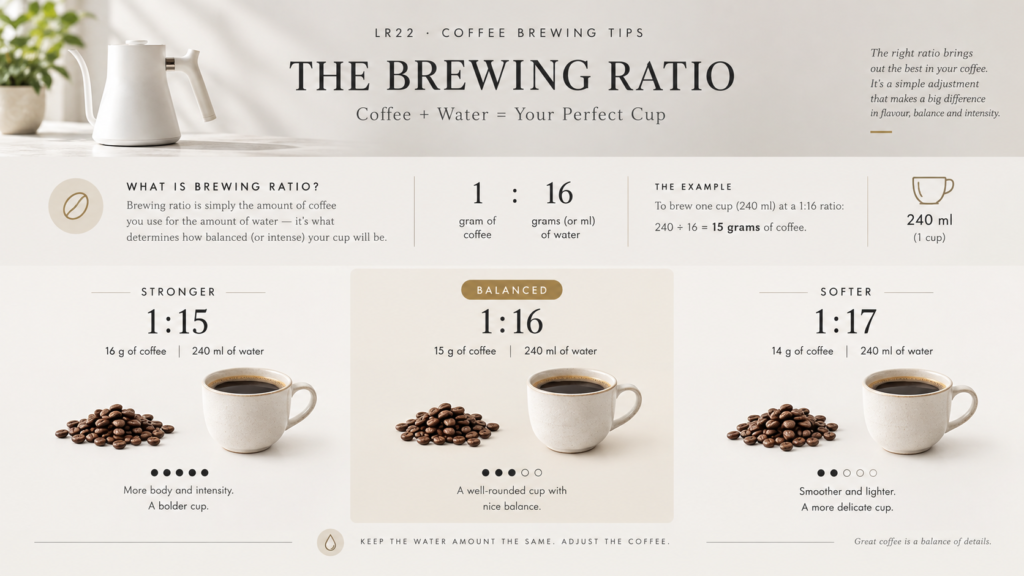
Brewing ratio is simply the amount of coffee you use for the amount of water, it’s what determines how balanced (or intense) your cup will be.
Brewing Ratio in Practice
A ratio of 1:16 means 1 gram of coffee for every 16 grams (or milliliters) of water.
To brew one cup (240ml) at that ratio: 240 ÷ 16 = 15 grams of coffee.
Want it softer? Go up to 1:17 → 240 ÷ 17 = 14g.
Want more body and strength? Go down to 1:15 → 240 ÷ 15 = 16g.
The rule is simple: a lower ratio number makes a stronger cup, a higher one makes it lighter.
No scale yet? One heaping tablespoon of ground coffee weighs about 5.5g, so a single cup (240ml) needs roughly 3 tablespoons.
Why Water Temperature Matters
Water that’s too hot over-extracts the coffee, pulling out bitter, astringent flavours. Water that’s too cool under-extracts it, leaving a flat, salty cup with no real body. The sweet spot is 92–94°C — never above 95°C.
No thermometer? Boil your water, then let it rest for about a minute and a half, that puts you right in the 90–95°C range.
Solving the Puzzle: Why Doesn’t My Coffee Taste Right?
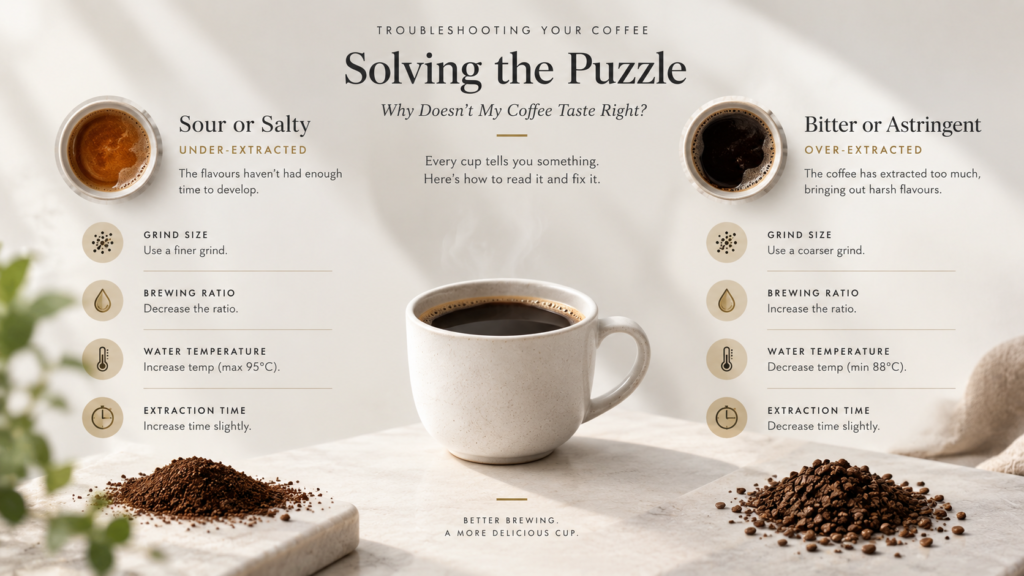
Every cup tells you something. Here’s how to read it and fix it. Grind size is one of the most important factors affecting flavour, but remember: brewing can only bring out what’s already in the coffee. You can adjust your technique, but a poor-quality coffee won’t produce a great cup—starting with good coffee is essential for good results.
| Parameter | If your coffee tastes sour or salty (under-extracted) | If your coffee tastes bitter or astringent (over-extracted) |
|---|---|---|
| Grind size | Use a finer grind | Use a coarser grind |
| Brewing ratio | Decrease the ratio | Increase the ratio |
| Water temperature | Increase temp (max 95°C) | Decrease temp (min 88°C) |
| Extraction time | Increase time slightly | Decrease time sligh |
Explore Each Recipe in Detail
Ready to brew specialty coffee at home?
In this section, you’ll find a collection of educational brewing guides. Each method includes a detailed step-by-step guide and video to help you understand the process and get the most from your coffee.
→ 7 Easy Steps to Brew Coffee with the Pour Over V60 Method
→ 7 easy Steps to Brew coffee with the Pour Over Chemex Method, coming soon…
From Origin to Your Cup
Every method in this guide is built to honour what makes La Reserva 22 coffee different: beans grown with care in Colombia, roasted fresh here in Guelph, Ontario, and sourced through direct trade relationships with the farmers who grow them. However you brew it, you’re tasting that whole journey in one cup.
Frequently Asked Questions About Brewing Coffee at Home
What is the best coffee-to-water ratio for brewing at home?
Most specialty coffee methods work best with a 1:15 to 1:16 ratio — 1 gram of coffee for every 15–16 grams of water. Adjust up or down slightly to match your taste.
What water temperature is best for brewing specialty coffee?
Aim for 92–94°C for most methods. Going above 95°C tends to pull out bitter, over-extracted flavours.
Why does my coffee taste bitter, sour, or weak? It almost always comes down to grind size, ratio, or extraction time. See our troubleshooting table above to fix it in one adjustment.
What’s the difference between drip and immersion brewing methods?
Drip methods (V60, Chemex, Auto Drip) let water pass through the coffee bed continuously, producing a clean, bright cup. Immersion methods (Aeropress, French Press, Cold Brew) steep the coffee fully in water, producing a fuller-bodied cup.
Do I need a scale and thermometer to brew good coffee at home?
No. A scale and thermometer improve precision, but you can get great results with a tablespoon for measuring and a simple “boil and wait 90 seconds” trick for temperature.
Which brewing method is best for beginners if I want to brew specialty coffee at home?
The V60 or an Auto Drip machine (coffeemaker) are the most beginner-friendly, fewer variables to manage while you learn how ratio and grind size affect flavour.
Can I use tap water to brew specialty coffee?
Yes, as long as it’s not heavily chlorinated or high in minerals. For cold brew specifically, calcium-free (bottled) water gives the cleanest result.
What kind of coffee grinder should I buy: burr or blade?
Always choose a burr grinder. A blade grinder shatters beans into uneven pieces and coffee dust, which over-extracts and makes your cup taste bitter and muddled. A burr grinder crushes beans to a uniform size, so every particle extracts evenly. It’s the single most impactful piece of equipment for better coffee at home — see the hand grinders we carry.
Where can I buy fresh specialty coffee in Guelph?
La Reserva 22 roasts specialty Colombian coffee fresh right here in Guelph, Ontario. shop our current roasts or visit us.
Remember
Great Coffee isn’t magic…
It just starts with the right beans.
See you next brew ☕